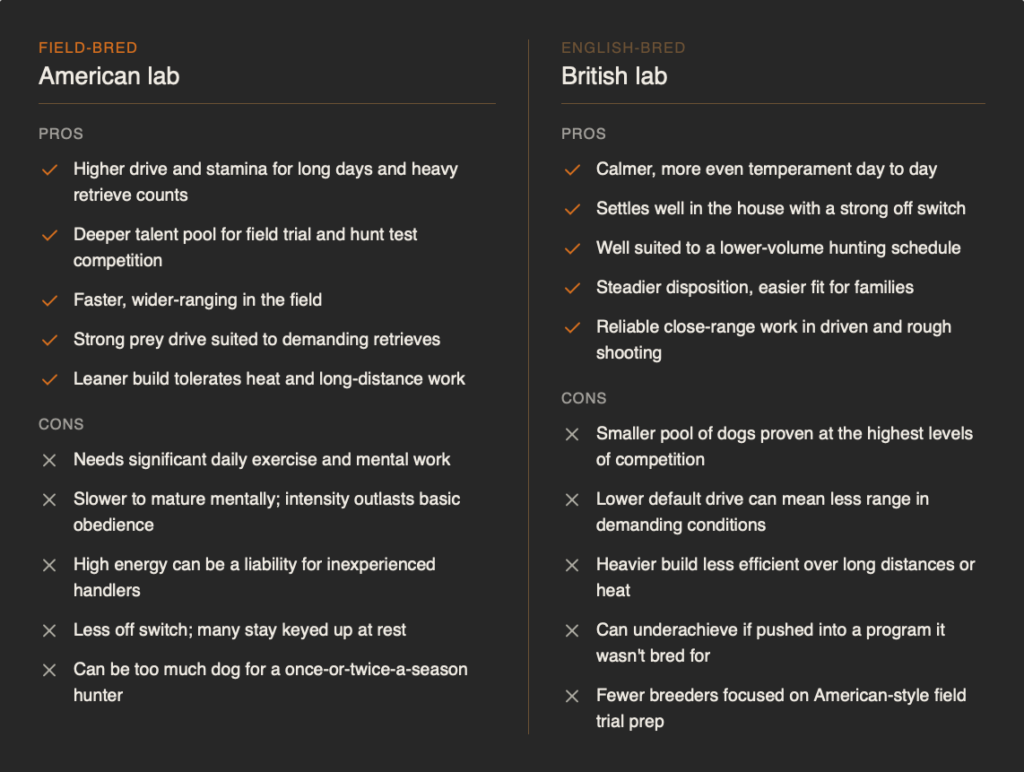
Quick answer: American Labs and British (English) Labs are the same breed developed for different jobs. American Labs are bred for drive, stamina, and field performance, the stronger bet for hunt tests, field trials, and SRS competition. British Labs are bred for a blockier build and calmer temperament, often a better fit for a casual, companion-first gundog. The right choice depends on how many days a season you hunt, how much drive you can manage at home, and whether you're chasing titles or just a steady bird dog.
Most Americans waste their breath arguing over whether Jordan or LeBron is the greatest of all time. But for those of us who've been bit by the duck hunting bug — or by any of the retriever sports — we tend to spend our time arguing about the virtues of American Labs vs. British Labs instead. There isn't a single man I've met who doesn't speak with the conviction of a freedom fighter staking his flag in the ground on one side of this issue. So once and for all: which dog is better, the American Lab or the British Lab?
For the sake of clarity, let's assume we're talking about the very best — the quintessential example — of each line.
American Lab vs. British Lab: Conformation and Breed Characteristics
Both are Labrador Retrievers. Same breed, same standard on paper. But decades of selective breeding toward different jobs have pulled the two lines apart — in build, in drive, and in what they're actually suited for.
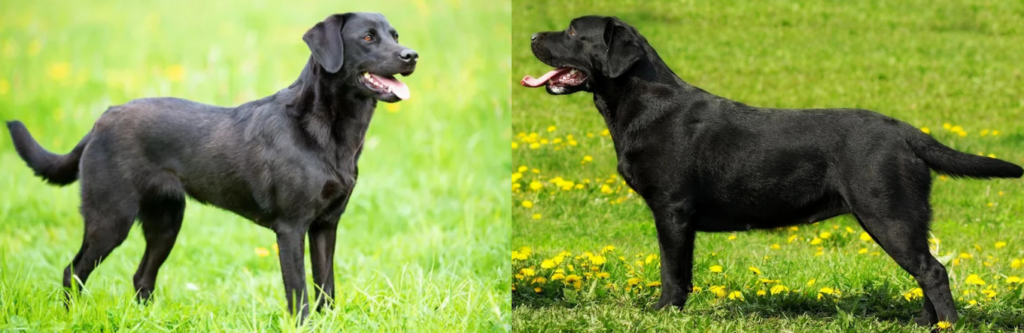
American Lab (Field-Bred)
Bred primarily for competitive field trials and hunt tests, the American Lab is built for speed and endurance over the long haul.
- Build: Leaner, more athletic frame; longer legs; less bulk through the chest and shoulders
- Coat: Shorter, thinner coat than the British line
- Head: Narrower skull, longer muzzle
- Movement: Built for range and speed - covers ground fast, works at a distance
- Drive: High energy, high intensity, bred to work for hours across multiple series
- Maturity: Slower to mature mentally; often intense well into adulthood
British Lab (English-Bred)
Bred largely to UK bench and working standards, with more emphasis on structure and temperament for driven shooting and rough shooting.
- Build: Blocker, more compact frame; shorter legs; heavier bone and chest.
- Coat: Thicker, denser coat.
- Head: Broader skull ("blocky" head), shorter muzzle, more pronounced stop.
- Movement: Built for close, methodical work rather than covering wide ground at speed.
- Drive: Steadier, more even temperament; lower default intensity.
- Maturity: Tends to settle earlier, often calmer in the house as an adult.
There's No Universal Answer — Only the Right Fit
If you're hoping for a definitive answer, I'm sorry to disappoint you. The truth is, which is better is a highly subjective question that really boils down to this: it depends.
It depends on both your needs and some of your personal preferences. Are you a guide who hunts 50 days a season and needs a dog that can pick up 1,200 birds a season — or a casual hunter who may only take your dog out five or six days a season? What tradeoffs are you willing to make? Is it more important to have a calm dog in the house who's an okay dog in the field, or do you prioritize a hard-charging dog that will chase down a cripple 200 yards away but will require copious amounts of daily exercise? Are you looking for a companion gundog, or do you hope to win an SRS Crown Championship?
If you are in fact looking to compete with your dog in any of the dog sports, or you simply want a highly capable dog in the field, the probability of finding that ideal dog is much higher in a high-quality, high-drive American Lab line than it would be from a British Lab line. That isn't to say there are no British Labs capable of competing at the highest levels — because there are. But they are the exception, not the rule.